
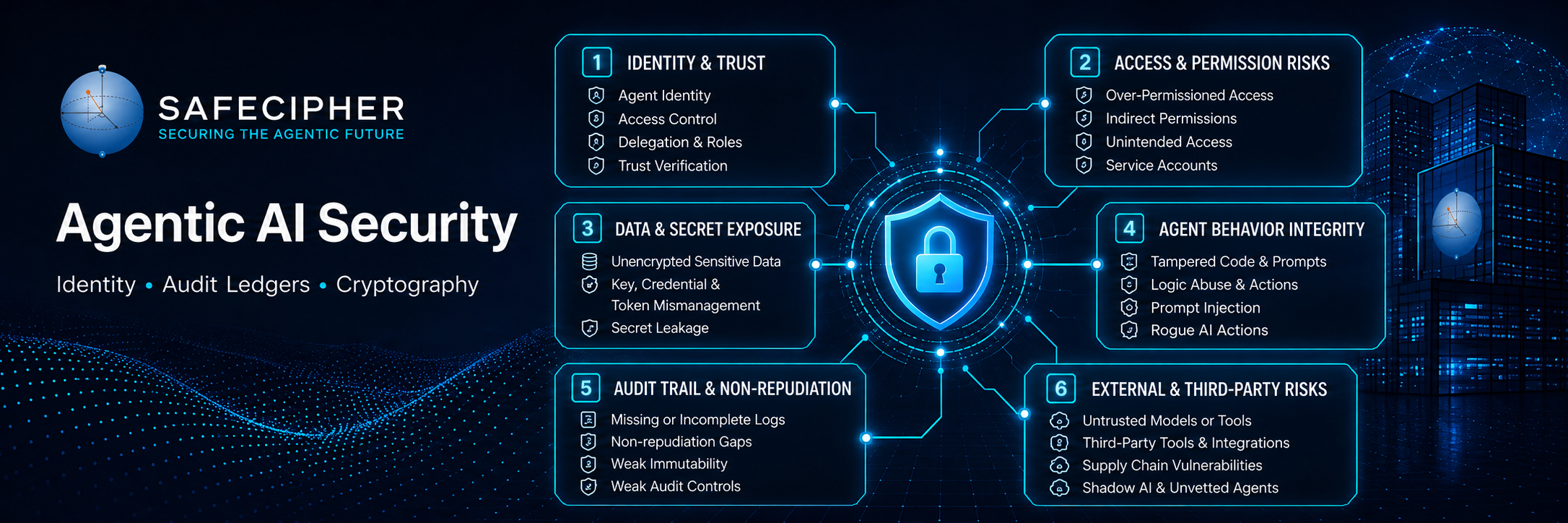
SafeCipher Agentic AI Security
Cryptography, Identity and Trust for Agentic AI
Agentic AI changes the cryptographic problem. Autonomous agents do not simply call an API: they authenticate, inherit permissions, exchange tokens, open mTLS sessions, access tools and data, invoke other agents, and generate evidence that may later need to prove exactly what happened. SafeCipher focuses on the cryptographic control plane that makes those interactions trustworthy.
Designed for security architects, platform engineers, AI engineers, PKI teams, cloud security teams and technical assurance functions. Vendor-neutral and applicable to cloud, hybrid, on-premises and service-mesh environments.
The engineering problem
In a traditional application, the cryptographic trust path is often relatively static. In an agentic estate, the path can be dynamic: an agent may obtain a workload identity, call another agent, receive a delegated token, use a secret to invoke a tool, write a decision record to an audit ledger, and cross several service-mesh or cloud trust boundaries in a single workflow.
Can you prove which agent acted, under whose authority, using which credential or key, across which trust path, and whether the resulting evidence can be altered or replayed later?
Six cryptographic control domains for Agentic AI
These are the areas we examine when assessing how cryptography is consumed by agents and the infrastructure around them.
Agent Identity & Delegated Trust
- How each agent, workload and service obtains a cryptographic identity.
- X.509, SPIFFE/SPIRE, workload identities, service accounts and short-lived credentials.
- Delegation chains: user → agent → sub-agent → tool or service.
- Audience, scope, expiry and replay protection for tokens.
- Whether one agent can impersonate another or inherit excessive authority.
Zero Trust, mTLS & Service Mesh
- Mutual authentication between agents, APIs, tools and data services.
- mTLS certificate issuance, rotation, validation and revocation behaviour.
- Service-mesh trust domains, sidecars, gateways and cross-cluster trust.
- Identity-aware policy rather than network-location trust.
- Certificate and CA dependencies that create hidden blast-radius risk.
Keys, Secrets, Tokens & Crypto Consumption
- Where API keys, signing keys, encryption keys, certificates and tokens are created and stored.
- KMS/HSM use, local secret stores, environment variables and CI/CD injection paths.
- Key provenance, access policy, rotation, escrow and break-glass controls.
- Agent access to cryptographic material outside its intended trust boundary.
- Shared credentials, long-lived secrets and secret propagation between agents.
Audit Ledgers, HMAC & Tamper Evidence
- Canonical record construction and deterministic serialisation before MAC/signature calculation.
- HMAC chaining between records and detection of modification, deletion and re-ordering.
- Key separation between application operation and ledger verification.
- Rotation of HMAC keys without losing historic verification capability.
- Protection against rollback, truncation, backup restoration and privileged ledger regeneration.
Integrity, Provenance & Agent Actions
- Integrity of prompts, policies, tools, model artefacts and agent configuration.
- Signing and verification points within build and deployment pipelines.
- Traceability between instruction, policy decision, external call and resulting action.
- Protection against unauthorised agent behaviour and unverified tool invocation.
- Evidence sufficient to reconstruct an incident after the event.
Algorithm Agility & PQC Exposure
- RSA/ECC dependencies within agent identities, TLS, signatures and trust stores.
- Algorithm assumptions embedded in SDKs, service meshes and platform integrations.
- Crypto-agility of certificates, protocols, audit evidence and key-management systems.
- Long-lived data or evidence exposed to harvest-now-decrypt-later risk.
- Practical migration paths toward hybrid and post-quantum mechanisms where appropriate.
HMAC-linked audit ledgers: what we actually verify
A chained HMAC ledger can provide strong tamper evidence, but only if the record format, chaining logic and key-management model are designed correctly. The HMAC itself is only one part of the control.
Record construction
- Stable field ordering and canonical serialisation.
- Explicit inclusion of sequence number, tenant, timestamp and previous-record digest.
- Protection against ambiguous or alternate encodings.
Chaining & verification
- Each record binds cryptographically to the prior record.
- Verification detects modification and broken chain continuity.
- Independent checkpoints can expose truncation or rollback.
Key architecture
- HMAC keys protected by HSM/KMS where appropriate.
- Per-tenant or per-ledger key separation.
- Rotation and historic validation without weakening old records.
HMAC provides integrity and authentication between parties that share the secret key. It does not by itself provide cryptographic non-repudiation, because any holder of the HMAC key can create a valid MAC. Where independent proof is required, the design may need asymmetric signatures, external checkpoints, witness services, signed Merkle roots or another independently verifiable trust mechanism.
Zero Trust and service-mesh security for AI agents
Agentic systems frequently sit inside Kubernetes, service meshes and cloud-native control planes. The security question is not simply “is TLS enabled?” — it is whether identity, certificate issuance, policy and trust boundaries remain correct as agents are created, scaled and delegated new actions.
Workload identity
- Short-lived identities instead of static credentials.
- Clear mapping between workload identity and agent function.
- Automated certificate/key rotation without shared private keys.
- Attestation or registration controls before identity issuance.
Trust boundary enforcement
- mTLS for agent-to-agent and agent-to-service communication.
- Trust-domain and namespace isolation.
- Explicit policy for cross-mesh, cross-cloud and external SaaS access.
- Controls preventing lateral movement using a valid but over-privileged identity.
What SafeCipher can produce
The work can be scoped around a specific AI platform, agent framework, audit-ledger design, service-mesh deployment or broader enterprise Agentic AI architecture. It is not tied to a fixed duration.
Agentic cryptographic architecture review
Trust boundaries, identities, PKI, KMS/HSM dependencies, mTLS paths, secrets and cryptographic flows.
Audit ledger cryptographic assessment
Record format, HMAC chaining, key custody, rotation, rollback/truncation resistance and independent verification options.
Identity & service-mesh review
Workload identity, SPIFFE/SPIRE or equivalent mechanisms, certificate lifecycle, mesh trust domains and zero-trust enforcement.
Cryptographic risk register
Concrete findings covering weak trust paths, unmanaged credentials, over-privilege, crypto-agility gaps and remediation priorities.
Engineering remediation plan
Prioritised technical actions with ownership, dependencies and practical implementation guidance.
PQC / crypto-agility assessment
Identification of classical algorithm dependencies and where future hybrid or post-quantum migration should be designed in.
How an assessment normally starts
Architecture discovery
Understand the agent runtime, identity sources, service mesh, tool integrations, data flows, audit path, KMS/HSM and trust boundaries before defining findings.
Cryptographic verification
Examine the actual certificates, algorithms, keys, tokens, policies, ledger construction, configuration and evidence that implement the design.
Engineering recommendations
Produce actionable findings rather than generic AI governance statements: what is wrong, why it matters, what should change and what evidence proves the fix.
Who this is for
AI / Platform Engineers
You need to understand how agent identity, secrets, mTLS, tools, logs and infrastructure trust fit together in a deployable architecture.
Security & PKI Teams
You need visibility of new machine identities, certificate dependencies, KMS/HSM use, workload trust and cryptographic policy.
Technical Assurance
You need evidence that agent actions are attributable, audit records are tamper-evident, and critical trust paths can be independently verified.
Technical FAQ
Is this an AI governance service?
The focus is technical cryptographic assurance. Governance may be mapped where useful, but the core work examines identities, certificates, keys, tokens, mTLS, trust boundaries, ledger integrity and the evidence produced by the running system.
Can you review an HMAC-based immutable or tamper-evident audit ledger?
Yes. We examine record construction, canonical serialisation, chaining, HMAC key custody, key rotation, historic verification, deletion/reordering detection, rollback and truncation resistance, and whether independent verification is actually possible.
Can this cover Kubernetes, Istio, service mesh or SPIFFE/SPIRE?
Yes. The assessment can include workload identity, mTLS, service-mesh certificate lifecycle, trust domains, service-to-service policy, gateways and the PKI/KMS dependencies behind them.
Do you require a particular AI platform or vendor?
No. SafeCipher is vendor-neutral. The assessment is based on the architecture and cryptographic controls actually in use, whether the environment is cloud-native, hybrid, on-premises or assembled from multiple AI and security platforms.
Can PQC readiness be included?
Yes. We can identify RSA/ECC and other classical dependencies across agent identity, TLS/mTLS, signatures, trust stores and audit mechanisms, and assess the architecture for crypto-agility and future PQC migration.